Qigong Massage Parent Training to Address Autism
Autism, according to the Centers for Disease Control and Prevention (CDC) now affects 1 in 31 children, and the symptoms of autism spectrum disorder can be very challenging to address; parents are on the front lines, trying to navigate this condition to assist their children to be as healthy, happy, and functional as possible.
Qigong Massage, also known as Qigong Sensory Training (QST) is a groundbreaking, evidence-based method built on 15 years of clinical research; it has been shown to be extraordinarily effective. In fact, QST has been recognized in the American Journal of Occupational Therapy as a touch therapy providing “the most robust positive outcomes, indicating strong evidence of effectiveness for young children with ASD” (Bodison & Parham, 2018).
What is QST?
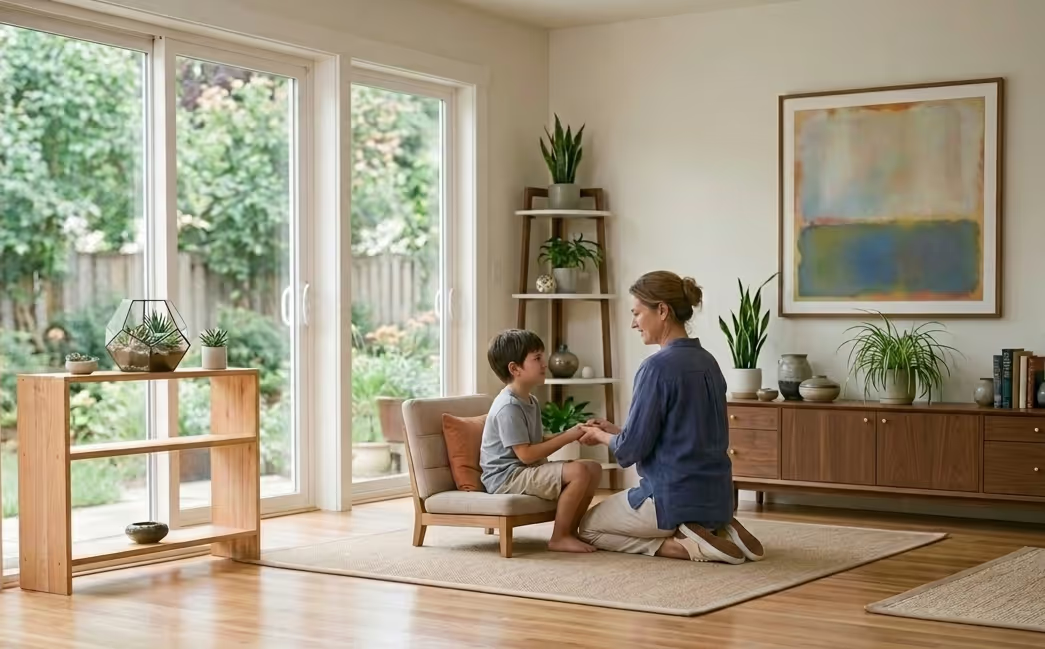
Qigong Sensory Therapy is a 15-minute daily massage that parents can be taught to provide for their autistic child at home to support their child’s development.
Certified therapists teach the parent(s), and the recommendation is for the parent(s) to provide the massage daily for at least 5 months. When performed consistently, the modality can produce profound, lifelong benefits.
Results are often apparent within 30 days and include improvements in sensory awareness, communication, sleep, digestion, behavior, motor skills, social skills, and bonding.
QST Research
Dr. Louisa Silva, the lead researcher for QST and founder of QSTI, through 15 published, peer-reviewed studies, found that Qigong Sensory Therapy promotes significant improvement in all common developmental challenges associated with autism.
In partnership with The Research Institute at Western Oregon University and The Bureau of Maternal and Child Health, QST researchers found, in a series of randomized controlled trials, that QST, as a stand-alone service, significantly reduced autistic symptoms.
After five months of QST as a stand-alone service, the studies found a 38% improvement in sensory processing, 49% improvement in comfort and awareness of touch, 34% improvement in self-regulation (social-emotional-behavioral challenges and challenges with sleep and digestion), 18% increase in receptive language, and a 44% decrease in parenting stress.
There was an overall improvement in social and communication skills and children were more affectionate.
After two years of QST as a stand-alone service, the studies found a 100% recovery in comfort and awareness of the sense of touch and a 44% decrease in social-emotional-behavioral challenges.
Over 50% of high-functioning children no longer met the criteria for an autism diagnosis. Studies focusing on younger (under age 6), as well as older (ages 6–12) showed similar results.
Learning to provide Qigong Massage can be an invaluable gift parents can give to their autistic child.
What support is available?
Suzy Edmonson, OT, RMT, certified QST parent trainer, provides video conferencing support, including demonstration of QST, as well as written and pictorial resources to assist parents in developing the skills needed to support their child.
Contact at: 817 996-9961; www.healingsynergies.org. Additional practitioners can be found at www.qsti.org.
References
Parham, D., & Bodison, S. (2018). Specific Sensory Techniques and Sensory Environmental Modifications for Children and Youth With Sensory Integration Difficulties: A Systematic Review. American Journal of Occupational Therapy, 72(1), 72011900401-720119004011. https://doi.org/10.5014/ajot.2018.029413
Qigong Sensory Training Institute (2026, April 8). www.qsti.org